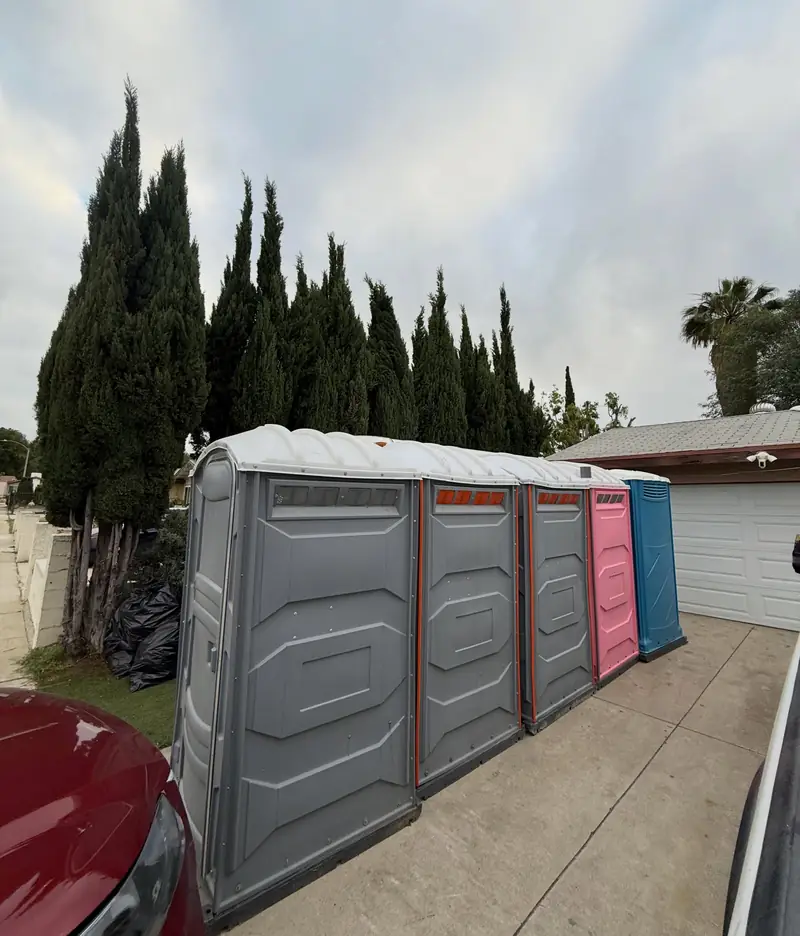
Where is the best place to put a porta potty?
The best place for a porta potty is level, firm ground with a clear path about 4 feet wide. The spot should be easy for guests or crews to find and close to where the truck can park. A driveway edge, gravel pad or flat patch of lawn usually works well.
A standard unit is about 44 inches wide, 48 inches deep and 90 inches tall. It weighs about 170 pounds empty.
A tilted unit rocks, and that makes users nervous. A level spot keeps the door closing right and the tank sitting flat.
Pick a spot people can see from the main area, but not one that faces the party. Turning the door toward a fence or hedge gives users a little privacy.
How much room does the delivery truck need?
The delivery truck needs to park close to the placement spot. The path from the truck needs to be about 4 feet wide. Restroom trailers need more: truck access all the way to the spot, plus level ground. Tell us about steep drives, soft ground and low branches when you book.
The last stretch from truck to spot needs to be clear. Steps, soft mud and long uphill walks make placement hard. Measure gate width before delivery day.
Hill Country lots often have caliche drives, limestone ledges and low oak limbs. This is common in Wimberley, Dripping Springs, Blanco and Canyon Lake. A quick photo of the drive helps the driver plan.
How far should a porta potty be from food and tents?
A portable toilet should sit a short walk away from food tables, coolers and the main tent. Downwind is better. Close enough matters too, because guests will not walk far at night. If food is served, add 1 hand-wash station for every 3 toilets and place it right beside them.
Local health rules for food vendors can set their own distances. If you have a caterer or food truck, ask them what their permit requires. Then place the restrooms to fit.
Keep units off the path guests use to reach the buffet. A good layout lets people go from restroom to hand-wash station to food without crossing a line.
Should a porta potty sit in the shade in Texas?
A porta potty should sit in the shade whenever possible in Central Texas. Summers here often top 95 to 100°F from June through September. Direct sun heats the plastic walls and speeds up odor. Afternoon shade from a building or tree on the west side helps the most.
Check the shade at the time of your event, not when you set up. A spot that is shady at 9 a.m. can be in full sun by 3 p.m.
Shade also matters for job sites. Our Texas summer heat guide covers odor, ventilation and extra service.
What about wind and tipping?
Wind can push a standard unit over. The unit stands about 90 inches tall and weighs about 170 pounds empty. Place units against a wall, fence or row of trees on open sites. Keep them away from hills and gaps where gusts funnel through. Ask about securing units on very open ground.
Spring storms in Central Texas bring strong gusts. Units on bare ranch land or new subdivisions feel those winds most.
Tipping by vandals is a risk on public job sites. A cheap padlock helps after hours. The renter is responsible for damage beyond normal use, so a protected spot is worth it.
Can I put a porta potty in my front yard?
A porta potty can usually go in a front yard or on a driveway. HOA rules may limit front-yard placement, though. Many HOAs allow a unit for a short time, such as a weekend or a remodel. Check your HOA rules before delivery. A side yard or driveway edge often avoids problems.
The driveway edge is often the easiest spot. It is level, firm and close to the truck. Leave room for cars to get in and out.
For a party, the side yard keeps the unit out of street view. Our backyard party checklist covers HOA and neighbor tips.
Do I need a permit to put a porta potty on the street?
A portable toilet on a city street, sidewalk or park usually needs a city permit or approval. The same goes for other public right-of-way. Private property, such as your own driveway or yard, usually does not. Rules differ in each city, so confirm the exact rules with your permit office or venue before you book.
In San Marcos, start with the City of San Marcos website. Street closures, block parties and park events often need a special event permit as well.
Festivals and public events have more steps. See festival porta potty rentals for planning large events.
How do I keep a porta potty out of flood water?
Keep porta potties out of drainage paths, ditches and low creek areas. San Marcos sits in Flash Flood Alley, and the San Marcos and Blanco rivers rise fast. The May 2015 Memorial Day flood showed how quickly water moves. We move units ahead of forecast flooding on request.
Look at where water runs during a hard rain. Avoid that line, even if the ground looks dry today. FEMA flood maps are online at the FEMA Flood Map Service Center.
East of I-35, Blackland Prairie clay turns sticky after rain. In Lockhart, Taylor, Hutto, Elgin and Manor, place units on gravel or the driveway edge after storms.
What should I know about gates, codes and lighting?
A standard unit needs a gate at least about 4 feet wide, so measure before delivery day. No one needs to be home if the spot is marked. Leave the gate open or share the code. Standard units have no lights, so plan lighting for any event after dark.
Mark the spot with a flag, chalk or a cone. Text or tell us the gate code when you book. The driver calls or texts about 30 minutes before arrival.
For night use, a few solar stake lights along the path help a lot. A battery lantern hung near the door works too. A restroom trailer has built-in lights, but it needs power.
Where should a wheelchair-accessible unit go?
A wheelchair-accessible unit needs a firm, level spot along a smooth path. The unit has a ground-level floor and a footprint of about 63 by 63 inches. Avoid gravel, thick grass and slopes on the path. Events need at least 1 accessible unit in each cluster of portable toilets.
Section 213.2 of the 2010 ADA Standards covers this. At least 5 percent of portable units in each cluster must be accessible.
See the U.S. Access Board ADA Standards. Our wheelchair-accessible porta potty is designed to meet 2010 ADA Standards dimensions.