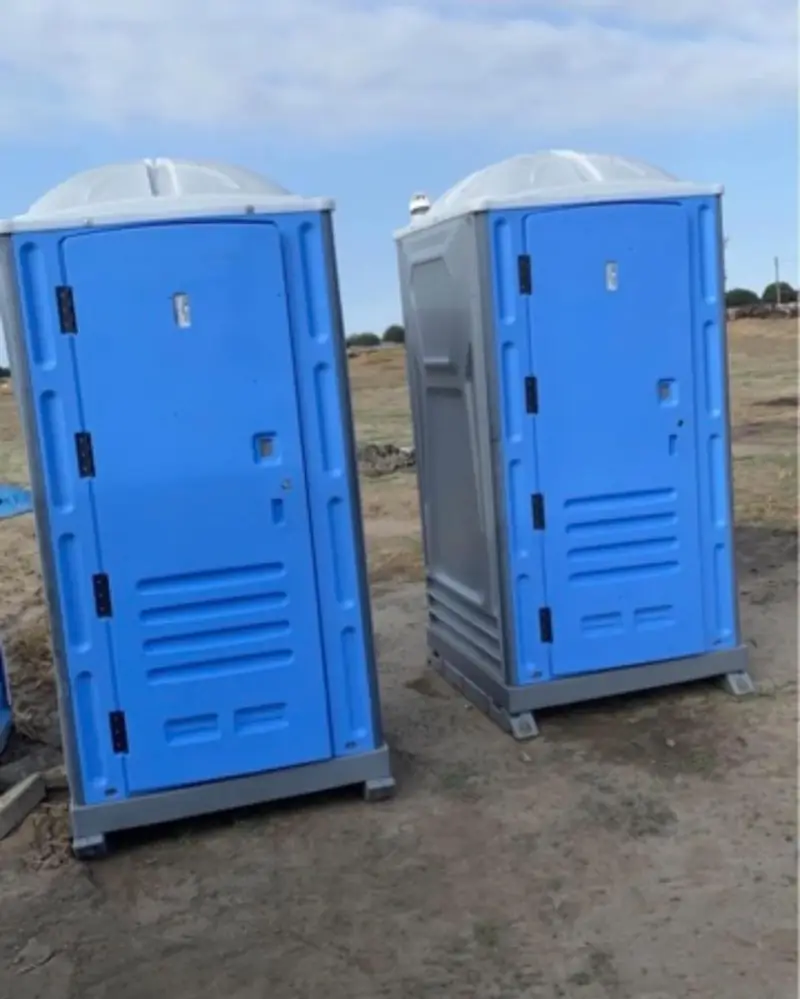
How many porta potties does OSHA require on a construction site?
OSHA rule 29 CFR 1926.51, Table D-1, sets the minimum toilet count for construction sites. A crew of 20 or fewer workers needs 1 toilet. A crew of 20 or more needs 1 toilet seat and 1 urinal per 40 workers. At 200 or more workers, the ratio becomes 1 seat and 1 urinal per 50.
The rule is part of the federal construction standard. You can read the full text on the eCFR page for 29 CFR 1926.51. Paragraph (c) covers toilets, and Table D-1 holds the ratios.
| Number of employees | Minimum facilities (Table D-1) |
|---|---|
| 20 or fewer | 1 toilet |
| 20 or more | 1 toilet seat and 1 urinal per 40 workers |
| 200 or more | 1 toilet seat and 1 urinal per 50 workers |
A standard porta potty has both a toilet seat and a urinal inside. So one standard unit counts as one seat and one urinal. That makes the table easy to turn into a unit count.
The rule also covers sites with no sewer. On those sites, chemical toilets or other approved units must be provided unless local codes say otherwise.
What do the OSHA numbers look like for 8, 25, 60 and 250 workers?
The OSHA minimum is 1 unit for 8 workers and 1 unit for 25 workers. It is 2 units for 60 workers and 5 units for 250. Those are legal floors, not comfort targets. With weekly service, one standard unit handles about 10 workers on a 40-hour week, so most crews order more.
The table below shows both numbers side by side. The first column is the legal minimum. The second is a practical count that keeps tanks from filling before the weekly service day.
| Crew size | OSHA minimum | Practical count with weekly service |
|---|---|---|
| 8 workers | 1 toilet | 1 standard unit |
| 25 workers | 1 seat and 1 urinal | 3 standard units |
| 60 workers | 2 seats and 2 urinals | 6 standard units |
| 250 workers | 5 seats and 5 urinals | About 25 units, or fewer with extra service visits |
8 workers
Eight workers fall in the "20 or fewer" row. OSHA asks for 1 toilet. One standard unit with weekly service fits this crew well.
25 workers
Twenty-five workers fall in the "20 or more" row. Divide 25 by 40 and round up to get 1 seat and 1 urinal.
One unit is legal, but 25 people will fill a 60-gallon tank fast. Three units, or one unit with more service visits, keeps the site usable all week.
60 workers
Divide 60 by 40 and you get 1.5. Round up to 2 seats and 2 urinals, which is 2 standard units. For a full 40-hour week, plan on about 6 units with weekly service.
250 workers
Crews of 200 or more use the 1-per-50 row. Divide 250 by 50 and you get 5 seats and 5 urinals.
Large sites often spread units in clusters near each work zone. Extra service days can cut the total unit count.
Want to run your own numbers? Use our porta potty sizing calculator.
Does OSHA require handwashing stations on a job site?
OSHA rule 1926.51(f) requires washing facilities when workers apply paint, coatings, herbicides or insecticides. The rule also covers other work where contaminants may harm workers. Those facilities must sit near the work area and let workers remove the substance. Many general contractors add a hand-wash station to every site anyway.
Concrete, drywall mud, solvents and sealants all leave residue on hands. Workers then eat lunch with those hands. A freestanding hand-wash station gives them soap, water and paper towels right next to the toilets.
A typical two-sink station holds about 30 to 40 gallons of fresh water. That is good for about 500 hand washes per fill. We refill it on the same weekly service visit as the toilets.
What are the OSHA toilet rules for farms and ranches?
Farm work follows OSHA rule 29 CFR 1928.110, not the construction rule. The rule covers farms with 11 or more workers doing hand labor in the field. They need 1 toilet and 1 hand-washing facility per 20 workers. Both must sit within a quarter-mile walk of each worker. Potable drinking water is also required.
Read the full field sanitation rule on the eCFR page for 29 CFR 1928.110. The rule has an exception for short shifts. It does not apply when workers are in the field 3 hours or less per day, including travel time.
Large ranches and orchards can make the quarter-mile rule hard to meet with one fixed unit. A seasonal farm or ranch rental can use a towable unit that moves with the crew.
Does Texas add its own porta potty rules for private employers?
Texas does not run its own OSHA state plan for private employers. Federal OSHA covers private job sites in Texas, so Table D-1 and 1926.51 are the main rules. We are not aware of state-specific toilet ratios beyond OSHA for private employers. Confirm the details with your safety officer.
Cities and counties can still add local rules. These usually deal with permits, placement on streets or right-of-way, and site plans. Some general contractors also write stricter ratios into their own safety programs.
Federal OSHA area offices handle Texas inspections. You can find contact details on the OSHA contact page.
Confirm the exact rules with your permit office or safety officer. This article is general information, not legal advice.
When does the OSHA construction toilet rule not apply?
The 1926.51 toilet rule does not apply to mobile crews that have transportation readily available to nearby toilets. A survey crew that moves to a new spot every hour may fall under this exception. Crews that stay on one site for a full shift usually do not.
The exception is narrow. "Nearby" and "readily available" mean the crew can reach a restroom quickly with a vehicle on hand. If workers must walk off site or wait for a truck, the exception likely does not fit.
When in doubt, put a unit on site. A single standard unit costs far less than a citation or lost work time.
How often should a job site porta potty be serviced?
Weekly service is the standard for job site porta potties. Table D-1 does not set a number of service days, but units must stay sanitary. One standard unit covers about 10 workers on a 40-hour week with weekly service. Larger crews and summer heat often need twice-weekly service.
Each service visit follows the same steps. The tech pumps the tank, cleans and sanitizes the inside, recharges the deodorizer and restocks toilet paper and sanitizer.
Central Texas summers often top 95 to 100°F from June through September. Heat speeds up odor, and crews drink more water.
For crews over 10 in summer, plan on two service visits a week. Our summer heat guide has more tips.
What should you have ready before ordering job site toilets?
Have four facts ready before you order job site toilets. You need peak crew size, start date, site address and gate access. A standard unit needs about a 4-foot-wide path from the truck. Delivery usually takes 1 to 2 business days, with same-day delivery possible when you call by noon.
Mark the placement spot with paint or a flag. Give us the gate code if the site is locked. No one needs to be on site for delivery.
Long jobs bill every 28 days, month-to-month, with no long contract. See construction site porta potty rental for unit options, or the porta potty rental cost guide for pricing.